



Your cart is currently empty!
What Are PVC Exterior Wall Cladding Panels? A Complete Guide for Indian Buildings

If you have ever owned or managed a property in India, you already know the annual exterior maintenance routine. The blistering peak summer heat bakes your walls, followed closely by continuous monsoon downpours that drench the structure for months. Add urban dust, traffic pollution, and humidity to the mix, and standard exterior paint starts peeling or flaking within just three to four years. Traditional stone or wooden facades, while beautiful, come with their own set of headaches—ranging from high structural weight and damp seepage to regular resealing costs.
That is precisely why the Indian architectural landscape is shifting. Property owners, builders, and architects are increasingly turning to PVC exterior wall cladding panels as a practical, high-performance solution.
Whether you are designing a modern villa, updating an older home facade, or setting up a commercial showroom, this guide breaks down everything you need to know about PVC exterior cladding: what it’s made of, how it survives the Indian weather, key cost drivers, and how it stack up against traditional alternatives.
What Are PVC Exterior Wall Cladding Panels Made Of?
It is common to confuse interior decorative PVC panels with exterior-grade cladding, but they are built for entirely different environments.
Exterior-grade PVC panels are manufactured via heavy-duty extrusion moulding using high-density, weather-grade Polyvinyl Chloride resin. Because standard PVC degrades when exposed to extreme outdoors, manufacturers blend the resin with specialized additives:
- UV Stabilisers (Titanium Dioxide & Light Stabilisers): These prevent solar radiation from breaking down the chemical bonds of the plastic. This ensures the panels do not fade, turn yellow, or become chalky under harsh sunlight.
- Impact Modifiers: These give the panel mechanical strength and flexibility. They ensure the material won’t crack if struck by flying debris during strong storms or accidental impacts.
- Thermal Expansion Buffers: Engineered to handle drastic ambient temperature changes—from freezing winter mornings in the North to blistering $45^\circ\text{C}$ summer afternoons—without warping or buckling.
- Fire Retardants: Modern exterior panels incorporate self-extinguishing additives to meet standard fire safety regulations for building facades.
The end result is an engineered material designed specifically to withstand prolonged rain exposure, intense humidity, and UV exposure over years of outdoor use.
How PVC Exterior Cladding Performs Against Indian Weather
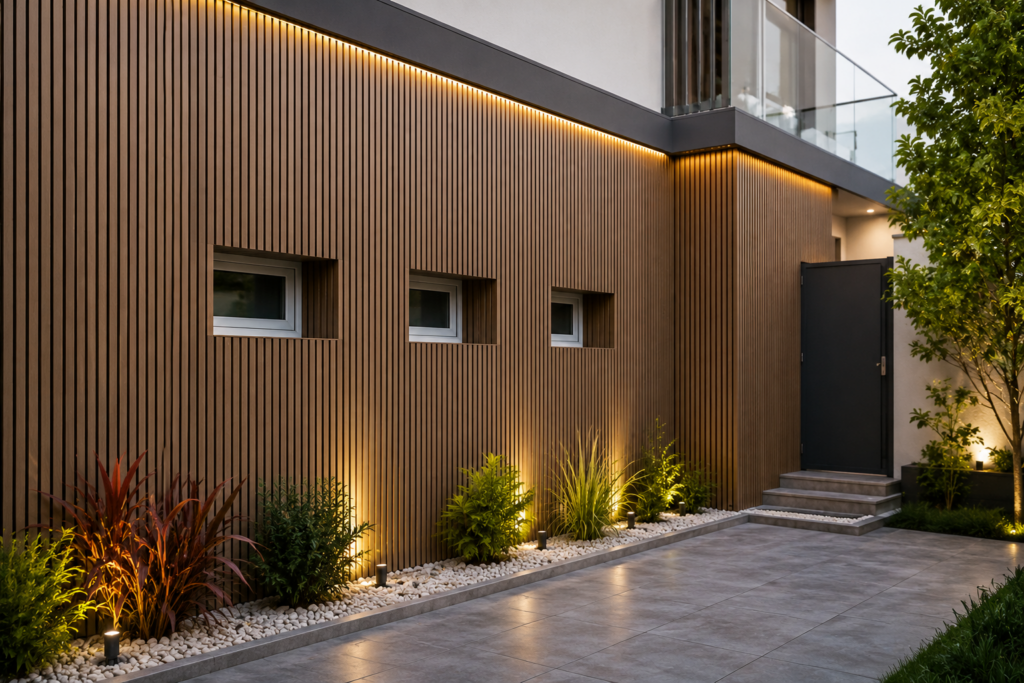
India’s climate is far from uniform. A material that works well in dry, arid regions might fail miserably along coastal belts. Here is a closer look at how exterior cladding PVC panels hold up across different climate zones in the country.
1. 100% Monsoon & Dampness Protection
Water ingress is arguably the single largest cause of building damage in India. When heavy rain hits plastered walls, water seeps into microscopic pores. Over time, this causes interior dampness, bubbling paint, structural efflorescence (white salt patches), and mold growth.
Exterior cladding panels act as a complete rainscreen. Because PVC is non-porous and completely waterproof, water simply runs off the surface without swelling, staining, or penetrating through to the structural brickwork behind it.
2. UV Stability in Sun-Drenched Zones
Ultraviolet rays degrade standard organic coatings, breaking down pigments and causing paints to fade unevenly. High-quality waterproof exterior wall panels are UV-stabilised throughout their core and protective topcoats. Whether installed on a south-facing facade in Rajasthan or a rooftop structure in Chennai, the material holds its color fidelity and physical strength year after year.
3. Thermal Insulation & Energy Savings
Direct sun hitting exposed brick or concrete turns walls into thermal radiators, soaking up heat all day and radiating it into living spaces at night. PVC panels are often installed on an aluminum or galvanized iron (GI) sub-frame, creating a small air gap between the panel and the real wall. This ventilated air cavity acts as a thermal buffer, significantly reducing thermal bridging into your home and easing the load on your air conditioning units.
4. Resistance to Urban Pollution and Coastal Salt
Cities deal with airborne soot, vehicular dust, and grime, while coastal towns face salty sea breezes that corrode metal and rot wood. PVC is chemically inert. It does not rust, pit, rot, or absorb oily pollutants. Cleaning a dirty facade requires nothing more than a quick spray with a garden hose or a mild detergent wash.
Why Homeowners and Builders Are Moving Away From Traditional Finishes
For decades, the standard choice for Indian exteriors was a simple matrix: exterior emulsion paint every few years, tiles, or natural stone for accent walls. While these materials have their place, the real-world operational challenges are hard to ignore.
The Repainting Cycle Trap
Exterior paint may look affordable during initial construction, but it carries a recurring financial burden. Repainting every 3 to 5 years involves high labor costs, surface scraping, scaffolding, primer applications, and nuisance for occupants. Over a 15-year lifecycle, the cumulative cost of repainting often far exceeds the upfront cost of installing durable external wall cladding.
The Weight and Maintenance of Stone
Natural stone (like granite, sandstone, or slate) looks stunning, but it introduces massive dead weight to the structural frame. Stone cladding also requires skilled labor, specialized adhesives, and periodic chemical sealing to prevent moss, algae, and water staining. PVC panels weigh a fraction of stone, install in days rather than weeks, and give you realistic wood, stone, or metallic textures without any of the structural load or porous maintenance.
Where Can Exterior Wall Cladding Panels Be Used?
One of the main advantages of modular exterior cladding is its versatility across structural shapes and design aesthetics.
- Residential Villa Facades: Elevate street appeal with rich wooden-fluted profiles or clean modern textures on front elevations, balconies, and dormer sections.
- Boundary Walls and Gate Pillars: Protect vulnerable boundary structures from ground moisture, rain runoff, and public wear.
- Commercial Buildings & Offices: Give corporate spaces a contemporary aesthetic that remains spotless and professional without calling in maintenance crews every season.
- Hospitality & Resorts: Ideal for resort cottages, outdoor dining zones, and poolside walls where constant exposure to moisture and sunlight quickly degrades lower-grade finishes.
- Renovation Overlays: Update the look of old, deteriorating building exteriors quickly without tearing down the existing plasterwork.
Direct Comparison: PVC Exterior Cladding vs Traditional Options
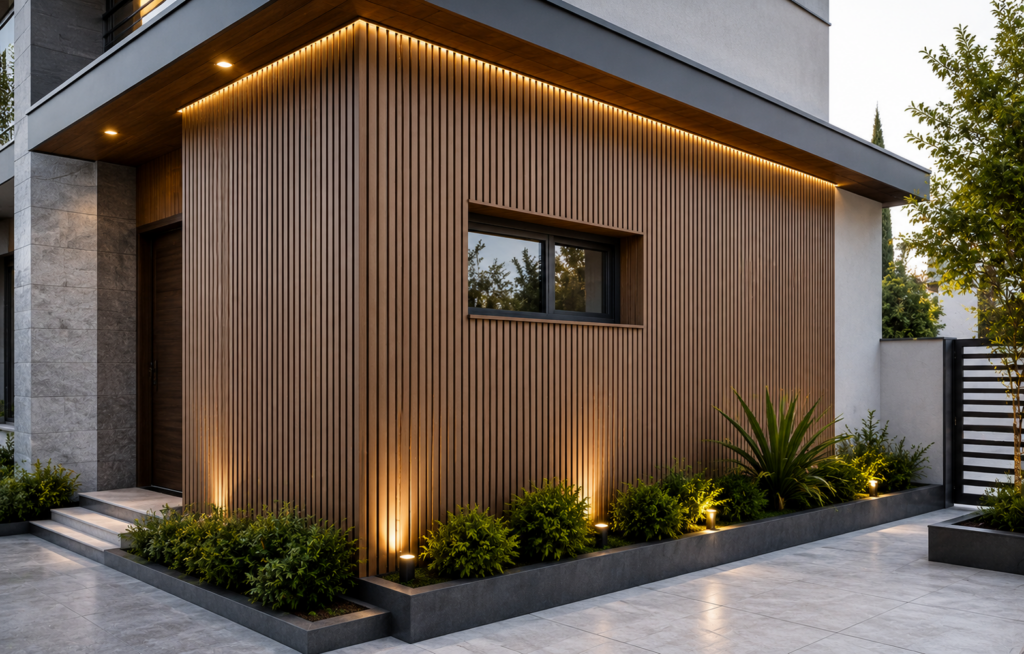
To help you evaluate your choices for your next construction or renovation project, here is how PVC cladding compares directly with paint, tiles, and wooden cladding.
| Comparison Factor | PVC Exterior Cladding | Standard Exterior Paint | Exterior Tiles / Stone | Real Wood Cladding |
| Water Resistance | 100% Waterproof (Zero absorption) | Low to Moderate (Prone to blistering) | High (Grout lines remain vulnerable) | Poor (Warps, rots without treatment) |
| Maintenance Need | Occasional water rinse | High (Repaint every 3–5 years) | Moderate (Tile replacement, regrouting) | Very High (Annual polishing & sealing) |
| UV Resistance | UV-Stabilised (Resists fading) | Fades, chalks, and discolors rapidly | Excellent | Fades & darkens over time |
| Installation Speed | Fast (Dry installation system) | Slow (Multi-coat wet process) | Slow (Wet masonry work required) | Moderate to Slow |
| Structural Weight | Very Lightweight | Negligible | Heavy to Very Heavy | Moderate |
| Termite/Pest Risk | Zero | None | None | High |
| Total 10-Yr Cost | Low (One-time investment) | High (Compounded labor & materials) | Moderate to High | High |
Key Considerations Before Buying and Installing
While PVC cladding offers obvious long-term benefits, achieving a clean finish that lasts decades comes down to product selection and proper installation technique.
1. Frame Sub-Structure
Exterior panels should never be stuck directly onto wet or uneven masonry with basic adhesives. They require a lightweight, level framework made of Aluminum or Galvanized Iron (GI) sections fixed to the wall. This framework creates a structural grid for panel attachment and allows for healthy air circulation behind the panels.
2. Allowing for Thermal Expansion
All polymers expand slightly when hot and contract when cold. Professional installers always leave tiny expansion gaps (usually 2 to 4 mm) inside the hidden joining channels or corner profiles. Forgetting this detail can cause panels to push against each other and buckle during summer peaks.
3. Choosing the Right Thickness and Density
For outdoor applications, avoid thin or hollow-core interior panels. Opt for heavy-duty, multi-chambered, or solid co-extruded outdoor-grade profiles with a thickness tailored to handle wind pressure and potential impacts at ground level.
Frequently Asked Questions
Is PVC exterior cladding suitable for coastal or high-humidity areas?
Yes. Because the panels are 100% waterproof, salt-resistant, and non-corrosive, they perform exceptionally well along coastal regions (such as Mumbai, Goa, Kerala, or Chennai) where humidity, salt-laden breeze, and heavy monsoon rains quickly degrade wood and metal cladding.
How long do PVC exterior cladding panels last?
When manufactured with outdoor-grade UV stabilisers and installed correctly on a proper sub-frame, high-quality exterior PVC cladding is designed to last 15 to 20+ years with minimal care—far outlasting standard exterior paint cycles.
Can exterior cladding panels be installed over an existing old building wall?
Yes! One of the biggest advantages of panel systems is that they can be fitted directly over existing exterior finishes (like old plaster, brick, or faded paint) using a supporting aluminum frame. This avoids the messy, costly process of hacking off old surfaces.
Do PVC exterior cladding panels fade in intense Indian summers?
Exterior-grade panels are embedded with UV inhibitors and sun-stable pigments throughout the outer layer. While any outdoor material experiences subtle weathering over long periods, quality exterior panels hold their color integrity without the dramatic fading or chalking seen in paint.
Is PVC cladding fire-safe?
Exterior-grade PVC cladding is engineered with fire-retardant additives. It typically carries a “self-extinguishing” rating, meaning that while it will char under direct external flame, it stops burning and will not propagate fire once the external flame source is removed.
Ready to Transform Your Facade?
Choosing exterior cladding is an investment in your building’s long-term protection, aesthetic appeal, and overall market value. By moving away from frequent repainting cycles and high-maintenance natural materials, you get a beautiful finish that stays pristine season after season.
Want to see exterior cladding panel samples before you decide?
Visit the Delby showroom in Ludhiana to inspect materials, textures, and finish options in person—or request a custom sample kit delivered straight to your doorstep online!
